
When I started my Ph.D. in 2016, it was a well-established norm in my area of systems security within computer science that you could defend a dissertation and graduate once you had three top-tier publications (meaning USENIX Security, ACM CCS, IEEE S&P, or NDSS) on a related topic.
Since then, the number of submitted papers has increased by a factor of 5.3. Review committees—their size, interests, and competencies—have expanded to compensate, and I now regularly hear complaints from both faculty and students that the publication process has become nearly random, if not completely so. Where it was once easy to maintain a well-calibrated internal compass for what was publishable and what was not—what counted as good research and what was still underbaked—that intuition has been overtaken by forces that seem almost otherworldly.
Students feel their degrees are being held for ransom. Universities are forced to mislead applicants into believing that a Ph.D. takes five years to complete (the average has been slightly over six years for engineering since 1995, according to the National Research Council). I recently spoke with someone who stepped down from the steering committee of a major conference after concluding that his efforts to reform it were futile. Defending with three top-tier publications is now a cause for ecstatic celebration rather than the norm.
So where have these papers gone, if not to conferences and journals?
The answer is arXiv. For the uninitiated, arXiv is a service for informally publishing papers without extensive peer review. For researchers who feel stifled by the bureaucracy of review committees, arXiv has become a bastion for rapidly disseminating new findings.
And its popularity is growing.
I now see conference reviewers cite arXiv papers as often as—if not more often than—formally published work. Meanwhile, formally published research often lags several years behind the cutting edge due to bloated revision and resubmission cycles. This naturally raises the question: why are we still putting up with the formal venues?
To better understand this trend, I used CSRankings to randomly identify 343 security research faculty from the top 25 universities in security (according to the site) and then mined public sources to collect their publication records. I filtered this data to count the number of formal publications (conferences, journals, workshops) and the number of informal publications (arXiv) for each researcher. The result for the past four years is shown below:
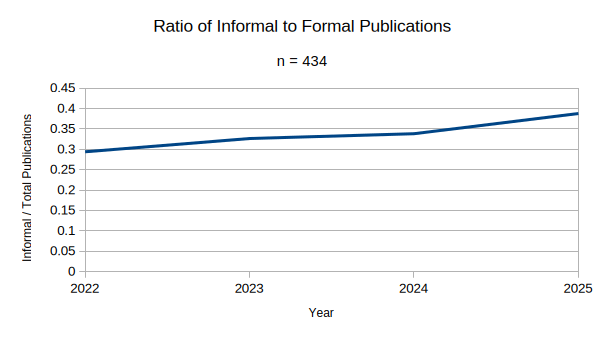
Last year, 38.8% of publications were from arXiv—almost a 10% increase from 2022. At this rate, one in every two papers will be an arXiv paper by 2028. That would represent a massive shift for an ecosystem as large and slow-moving as academia. Keep in mind that this dataset consists of top researchers at the most active universities in this field—the people most capable of getting papers accepted at formal venues.
Formal venues are failing academia. While they continue to muddle through slow, incremental changes—often constrained by institutional inertia—researchers have simply found a new path forward, leaving traditional venues to drift toward irrelevance.
So what does the future hold?
My theory is that formal venues will follow the trajectory of cable television. Before the rise of social media and video-on-demand platforms, anyone with a dream of creating a popular show had to pitch their idea to a cable channel. If the channel approved the project, it would provide the funding needed to cover high production costs. The approval process was slow and difficult, and creators often had to compromise to satisfy decision makers. But once approved, they could focus on producing their show without worrying much about how it would find its audience. The cable channel already had the viewers, the brand, and the marketing infrastructure. Creators just had to provide the content.
This is essentially the role formal venues play in academic research.
But as we all now know, cable television was not destined to dominate forever. With the rise of platforms like YouTube, creators could produce their own content, build their own audiences, and establish their own brands. Cable television has not disappeared, but it has lost much of its market share and cultural influence.
Of course, there are no free lunches. YouTube has its own trade-offs. In exchange for independence from gatekeepers, the responsibility for marketing and disseminating content now lies entirely with the creator. And if we examine YouTube statistics, we see that most channels attract little attention—often just a handful of videos with a few views. The implications for academia are profound.
This is the direction the arXiv model is pushing us toward. To prepare for that future, we need to rethink how we disseminate research and how we measure success.